
ISSN: Applied For · Est. 2026
Assam Journal of Anaesthesiology
Anaesthesiology · Critical Care · Pain Medicine
Anaesthesiology · Critical Care · Pain Medicine
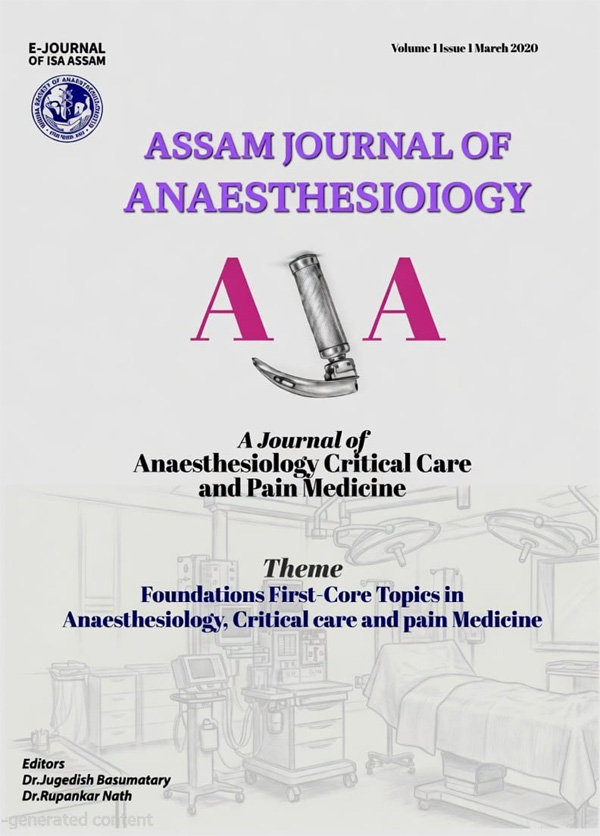 |
|
| Title | Assam Journal of Anaesthesiology |
| Frequency | 3 Issues / Year |
| ISSN | Applied For |
| Publisher | Indian Society of Anaesthesiologists, Assam State Branch |
| Publisher Address | Namtila Pather, PO – Sivasagar, Dist. Sivasagar, Assam 785697 |
| Starting Year | 2026 |
| Format | Online (Open Access) |
Vol. 1, Issue 1 — March 2026
Contains 6 review articles, editorials, and messages from ISA Assam leadership.
Email your manuscript to us in .docx format
Email: assamjournalofanaesthesiology@gmail.com
Double-blind peer review by ≥2 independent reviewers.
Anaesthesiology Critical Care Pain Medicine
Anaesthesiology is a vibrant and ever evolving specialty — a cornerstone of healthcare that ensures patient safety and comfort across a spectrum of surgical and medical procedures. The scope of our practice is broad, encompassing not only the operation theatre but also intensive care units and chronic pain management clinics. This journal aims to cover all these areas, offering a comprehensive resource for professionals in Assam and the wider medical community.
Assam, with its unique geographical and demographic characteristics, faces specific healthcare challenges. A regional journal provides an essential platform for our members to publish what is locally relevant, ensuring that our collective experiences and findings contribute directly to improving local patient care and outcomes. It encourages academic writing and research among young anaesthesiologists who might otherwise find it challenging to publish in high-impact national or international journals.
The success of this journal depends entirely on the active participation and contribution of our members. We are committed to fostering a culture of evidence-based practice and lifelong learning within ISA Assam State Branch.
Former Professor & HOD
Department of Anaesthesiology & Critical Care
Gauhati Medical College, Guwahati, Assam
Professor, Department of Anaesthesiology and Critical Care
Kokrajhar Medical College and Hospital
Bodoland Territorial Region, Assam 783370
Professor (DACP), Department of Anaesthesiology and Critical Care
Silchar Medical College and Hospital
Silchar, Assam 788014
Associate Professor, Department of Anaesthesiology
Nalbari Medical College and Hospital
Senior Consultant, Anaesthesia and Critical Care
Swasti Hospital, Rangia
All manuscripts undergo a double-blind peer review process. Each article is reviewed by at least two independent reviewers. The Editor makes the final decision regarding acceptance or rejection.
All submissions are checked for plagiarism. Manuscripts with significant plagiarism will be rejected. Authors are expected to submit original work only.
Authorship must be based on substantial contributions to the study, data analysis, and manuscript preparation. All authors must approve the final version.
Authors must disclose any financial or personal conflicts of interest. If none exist, a statement declaring no conflict of interest must be included.
Studies involving human subjects must follow ethical standards. Ethics committee approval and patient consent must be obtained where applicable.
Authors retain copyright of their work. By submitting, authors grant the journal the right to publish the article online for academic purposes.
Use of AI tools in manuscript preparation must be disclosed. AI tools must not be listed as authors. Authors remain fully responsible for accuracy, originality, and integrity.
Inaugural Issue | Assam Journal of Anaesthesiology
This review explores the mechanisms of unconsciousness from an anaesthesiology perspective, defining consciousness through clinical characteristics such as wakefulness and awareness. General anaesthesia induces a unique, reversible state distinct from natural sleep, where unresponsiveness does not necessarily equate to unconsciousness. This review article examines the Neural Correlates of Consciousness (NCC) and neurophysiological mechanisms, detailing how anaesthetics disrupt information integration across cortical and subcortical networks. Furthermore, it discusses neurochemical mechanisms, specifically the modulation of neurotransmitters like GABA and NMDA, and ion channels, which underpin the loss of consciousness.
Neuromuscular blocking agents (NMBA) are an integral part of modern anaesthesia, used in both operation theatres and intensive care units, facilitating tracheal intubation, optimizing surgical conditions and aiding mechanical ventilation. The advent of newer generation NMBAs including Rocuronium, emerging ultra-short acting Gantacurium and CW002 promise rapid onset with spontaneous recovery and minimal cardiovascular effects. Novel reversal drugs like Calabadion and cysteine-based compounds are under development, aiming for broader and faster antagonism of neuromuscular block.
This overview elucidates the physical principles essential to anaesthesia breathing systems, connecting theory to clinical safety. It explores fundamental gas laws, including Boyle's, Dalton's, and Henry's, explaining their role in gas uptake and delivery. The text analyzes flow dynamics, resistance, and compliance, illustrating their impact on the work of breathing. Furthermore, it details the classification and mechanics of Mapleson circuits (A–F) and circle systems, addressing rebreathing, dead space, and fresh gas flow requirements.
Fascial plane blocks (FPBs) have witnessed a surge in clinical practice as integral components of opioid-sparing multimodal analgesia. Unlike traditional techniques, FPBs deposit local anaesthetics into inter-fascial spaces, relying on complex mechanisms such as bulk flow, diffusion, and vascular uptake to modulate pain. This review elucidates the anatomical basis and pharmacological behaviour of FPBs, underscoring their value when neuraxial blocks are contraindicated.
Antibiotic stewardship in the Intensive Care Unit (ICU) is a pivotal challenge for intensivists, particularly within India's semi-open ICU systems. Inappropriate antibiotic use accelerates drug resistance, increases mortality, and raises treatment costs. This document summarizes core elements for successful stewardship programs, which rely on strong leadership, accountability, and multidisciplinary collaboration. Essential strategies involve antibiotic "time outs" after 48 hours, reassessment, prospective audits, and pharmacy-driven interventions.
Pain is a complex, multidimensional protective mechanism involving sensory, emotional, and cognitive components, rather than a simple stimulus-response phenomenon. This overview delineates the ascending pain pathway, spanning transduction by nociceptors and transmission via afferent fibers to conscious perception in the brain. It further explores the nervous system's capacity to modulate signals through peripheral sensitization, spinal mechanisms like the Gate Control Theory, and descending inhibitory pathways involving endogenous opioids.
Namtila Pather, Post Office – Sivasagar
Police Station – Sivasagar, Dist. Sivasagar
Assam, PIN 785697
Email your manuscript in .docx format to the above address along with your cover letter and declarations.